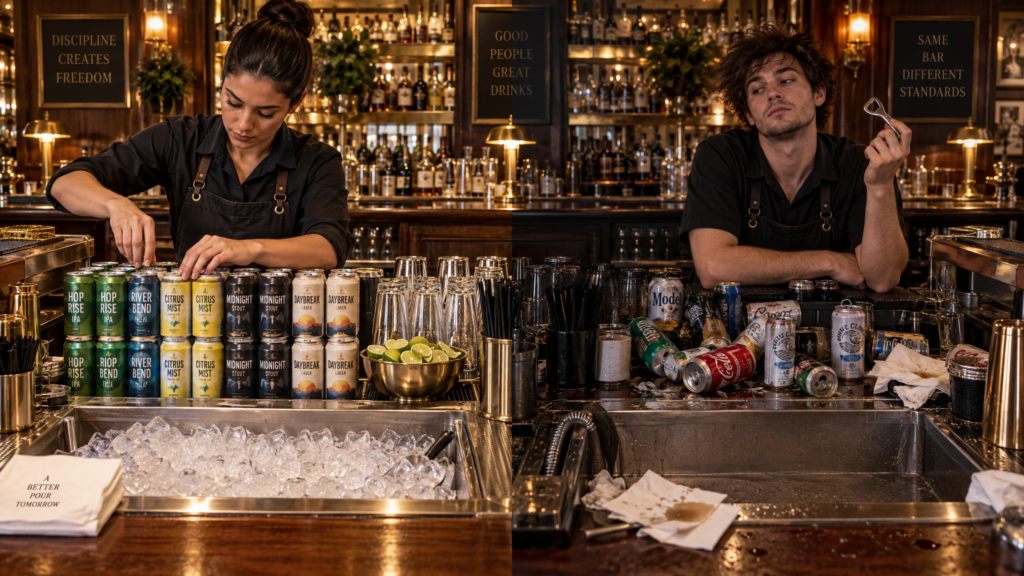
THE GOOD, THE BAD, AND THE UGLY
Bartending is hard work. In some places, bartending and being your own barback is your only option. This kind of filthy glassware is what you’re going to find behind your bar, sitting amongst your “sort of clean” glassware at SOME jobs where you have a barback “helping you” by setting up your bar’s basics… this is nothing short of pure and simple sabotage out to destroy the employer – it’s the “Death by 1,000 Cuts” … little cuts here, little cuts there that all add up until the entire reputation of the business is so damaged that it cannot recover as long as the employees performing this kind of sabotage are paid to work there.
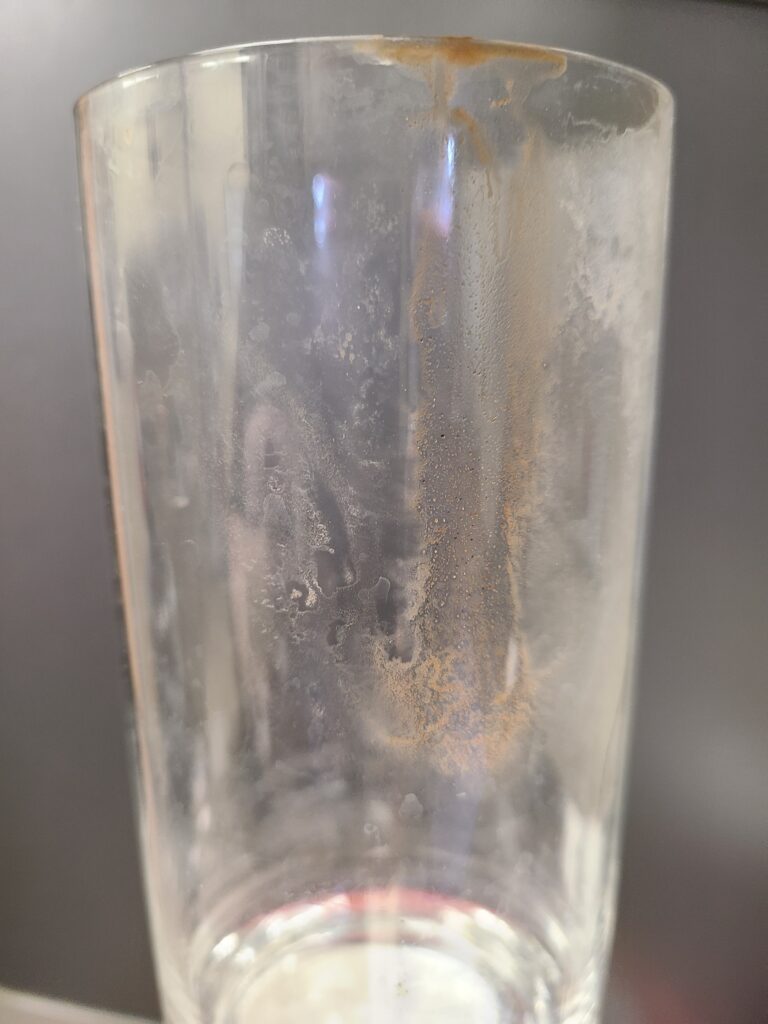
Same shit show day… one of DOZENS of glasses found by the bartender hidden amongst the rest of the semi-clean (???) glasses BEHIND THE BAR, READY TO GRAB QUICKLY DURING THE RUSH – for service that same day!
As someone who has had to self-barback, I can say the job is easy enough: come in prepared with a mental or written list of what needs immediate checking.
Which bottles in the rail and on the back bar are low and need immediate backup so you have them ready the moment the originals run out?
Which bottles of wine need restocking? Which glassware is running out? Which beers? Sodas? Syrups? Mixers? In other words, look at everything—including the garnishes and specialty drink ingredients. Check the bitters. Are there Orange Bitters, Peychaud’s Bitters, and Angostura Bitters, at a bare minimum?
Just as a good bartender will perform an opening inventory and make a quick list of everything needed to begin the day, a good barback should do the same immediately so the bartender can move on quickly, finish setting up the bar, and begin serving without delay. Good barbacks move as quickly and work as hard as the bartenders they aspire to become.
If a barback cannot ready a bar for service, then that barback will not be able to work as a bartender when there is nobody there to help set it up. A horrible barback, when forced to barback for themselves while tending bar, will be a horrible bartender—and will be hated by the bartender who takes over the bar when they leave. It’s that simple. Run a shit-show bar and hand that shit-show over to the next bartender taking over the station, and that person will be hated—even if nothing is said.
Good barbacks make sure garnishes are kept fresh. Limes should be green and as unblemished as possible, cut twice daily in small batches—always glistening, never dried out, never browning around the edges, and never slimy or swimming in old juice in an unwashed or undried container. Lemons should be cut fresh at least once every 36 hours, or every three shifts. Oranges shouldn’t be shriveled and dried out, or slimy and covered with a white film in the container they’re sitting in—the garnish tray.
FRIDGES ARE ORGANIZED!
Red Bulls—all flavors—High Noons—all flavors—and similar products should be separated by rows, with the COLD ONES UP FRONT and the warmer ones toward the back. They should be FACING FORWARD so the labels can be read by the bartender who is in a hurry to fill orders.
A horrible barback will toss all the Red Bulls and High Noons in like a bouquet of flowers, mixing everything together without concern for label direction. The same goes for bottled beers: all the labels face sideways or backward, occasionally and by accident facing forward. A horrible barback won’t take direction from the bartender to put the warm ones in back or to PLEASE FACE THE LABELS FORWARD so they can be read.
A HORRIBLE barback flat-out DOESN’T CARE.
These people aren’t a help to bartenders. They’re more of a hindrance. Worse, they demand a tip-out without having done much of anything to help the bartender.
Good barbacks keep an eye on the level of ice in the ice bins behind the bar and refill them. Good barbacks who restock glassware keep an eye out for lipstick on the rims of glasses before and after washing—and DON’T DELIVER THAT FILTHY GARBAGE back to the bar for the bartender to grab in a rush. HORRIBLE BARBACKS do that—and expect to be tipped out for it.
Personally and professionally, I think we bartenders should deduct a dollar for every wine glass delivered to the bartender with lipstick on it. We’re mentoring these people to become bartenders, but we can’t fire them, and in corporate businesses today, we have no authority over them. However, we can tip them “as deserved” or withhold a tip as deserved. At least, that’s what we’ve all been told by management at the job where I’m currently working.
The barbacks I’m working with at present are assigned to three or four bars. Each bartender tips out their barback 20% of what they make, and the barback also earns a decent wage. That said, they also perform general Beverage Department work, so I don’t expect a barback to be around 100% of the time.
What I do expect is that, since I work hard all the time, bust my hump, break my back, and work quickly and professionally, my barbacks will give me solid, hard, fast, professional work—not talk, not cute little displays of twirling their bottle openers, not flirting with waitresses, not storytelling time, and not showing their dimples to everyone.
Instead, what I want and fully expect is solid, fast, concentrated work for all the time they spend at the bar where I work. I rely solely upon them to provide 100% effort and support so the bar runs quickly and efficiently, with high-quality results and as close to zero downtime as possible in every product area where proper stocking and temperature readiness are required to provide customer satisfaction. They need to keep up with every order slamming through the POS, no matter how busy it gets.
THAT’S WHAT GREAT BARBACKS DO.
Lousy barbacks do nothing.
Here’s some more: about the psychology of UGLY BAD Barbacks. The All Day, Every Day not giving a shit, fucking it up, and walking away, and of the Managements protecting them from being told flat out “You’re a Fuck Up 0 Do it right of get the fuck OUT, collect your shit and go the fuck home!!”
Bottles wiped clean and arranged by type (Cheapest 1st to premium), made to shine like the crown jewels. Single Malts separate from Blended, Bourbons the same – straight to blended separately… same with American and Canadian whiskies.
Keep knives sharp. Keep knives clean. Cutting boards clean. Use a can opener to open cans, not the knife tip. Don’t puncture pour syrups, juice.
Face all your speed pourers left. Kee0 all station ice bins filled at all times.
Face beers, sodas, energy drinks, ANYTHING WITH A LABEL forward to be easy to read quickly during fast service.
Rotate stock and never put warm beers in front of cold beers unless you want everyone to hate you (I already hate you just thinking about it).
If you fuck it up, clean it up. If you don’t know what to do, ASK or you’ll fuck it up.
LEARN TO READ AND TO COMPREHEND WHAT YOU READ.
Once a week pour a pitcher or two of boiling hot water down your soda gun drains (make sure your drain hoses are aimed into the floor drain first).
EXTRA BONUS if you learn how to unclog your soda gun and ice bin drain tubes.
Unless refrigerated – ice your juices and wines – not just set them on ice, but fill ice around them so they actually chill down.
Clean your Jiggers and your bar mats, your shaker tins, bar spoons, and muddlers. Clean is good. Don’t be a PIG.
ONLY nest your tins if they have been cleaned and dried thoroughly. Otherwise let them drain over a clean mat after rinsing out.
Sanitize and use logic – fill your caddies – if you use logo match books, napkins, etc, place the logos facing up, not down, so people can SEE them.
ANTICIPATE!
Pre-prep your glassware when it’s slow. Clean, polish, and arrange according to most used in closest proximity to the bartender’s hands – for SPEED! Speed equals profit.
Liquor Use: Check all bottles for par and pre-prep. What’s almost empty without a ready to open and FAST backup easily within instant reach? SPEED EQUALS PROFITS!
These rules are for bartenders and aspiring bartenders (barbacks) so if you’re bartending already this means you too.
That’s the beginning of professional bartending before learning the advanced Craft of the Cocktail.
